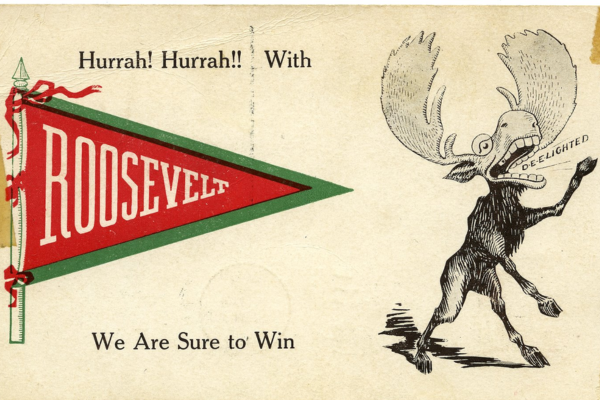
Today, it feels as though politics has never been more divided in American history. But, may I present to you the presidential election of 1912? Complete with fistfights, a convention walkout, and the largest third-party run in American history. 1912 is an election that gives any other a run for its money! This artifact spotlight article highlights a campaign postcard from that infamous 1912 election.
Shortly after his landslide 1904 victory, Theodore Roosevelt (“TR”) pledged that he would not run for a third term. TR stuck by that pledge despite remaining popular with both the public and the rank-and-file Republicans throughout his second term. Though his progressive policies caused friction within the more conservative Republican Party leadership, TR still could have easily secured renomination in 1908. Instead, when his term ended on March 4, 1901, , he left both the presidency and the Republican Party to his hand-picked successor and close friend, William Howard Taft. Taft had served as Secretary of War in TR’s administration (1904-08).
TR entrusted Taft to champion the same progressive ideals he had while in office. After leaving office, TR left the United States to go on a safari trip to Africa with his son, Kermit. However, Taft failed to follow in Roosevelt’s progressive footsteps as TR expected. Unfortunately for Taft, a series of missteps on policy cost him both public and progressive Republican support.
Thus, progressive Republicans turned to TR upon his return to the United States in 1910, in hopes he could challenge Taft. Despite being close friends, TR and Taft’s relationship worsened as Taft backtracked on TR’s progressive agenda. Initially, TR denied planning a run for the Republican nomination against Taft in 1912. However, in late 1911, TR declared his “hat in the ring” for the Republican presidential nomination. (Could you imagine running against a close friend to become president of the United States?!)
In 1912, many Republican voters did not get to vote directly in primaries like they would today. In a majority of states, party leaders chose which candidates to support at the convention. TR held a large lead in the states where voters selected candidates. However, Taft held a majority from states where the party leaders selected who to support. This edge would prove decisive for Taft, and he won the nomination. Once Taft was announced as the nominee, fistfights broke out throughout the convention hall between TR and Taft supporters. Viewing the nomination as one stolen from the progressives, TR and his supporters and stormed out of the Republican convention. That same day, TR’s supporters formed the Progressive Party. That new party made Theodore Roosevelt their candidate for president, a nomination which TR readily accepted.
On the eve of the Republican convention in Chicago, a reporter asked Roosevelt about his health and spirits for the campaign. TR replied, “I’m feeling like a Bull Moose!” This image became the symbol of the Progressive Party. Supporters of the party began calling themselves “Bull Moosers” and using the image throughout the campaign. The artifact spotlighted in this blog is a 1912 campaign postcard in support of TR’s Progressive Party. It features a Bull Moose cheering “D-E-LIGHTED” and the message that “Hurrah! Hurrah!! With Roosevelt we are sure to win.” Roosevelt ran on a policy platform known as “New Nationalism.” Roosevelt called for an increase in government power to enforce new regulations on monopolies and protect workers. Among his many policies, TR’s platform also called for women’s rights, direct primary elections (so the party leaders in states could no longer determine the victor of their states in the primaries), and a national healthcare system.
The Democratic Party nominated progressive New Jersey governor Woodrow Wilson. Roosevelt and Wilson competed over progressive voters (who made up a majority of the electorate in 1912). Taft campaigned as a conservative, meanwhile Socialist Eugene Debs also competed over a sizable portion of the voters as well.
The split in the Republican Party allowed Democrat Woodrow Wilson to win the White House. His victory was the first time the Democrats held the White House in two decades. Before that, the Democrats had only held the executive branch for 8 years (out of 52) since the Civil War (Grover Cleveland’s two non-consecutive terms as President between 1885-1889 and 1893-1897). Wilson received 41.8% of the popular vote and 435 electoral votes. Roosevelt received 27.4% and 88 electoral votes. Taft came third with 23.2% and 8 electoral votes. Roosevelt’s result to this day is the best for a third-party candidate in American history.
Talk about intense! I always find it fascinating to look back upon previous elections and all their interesting quirks and facts. Each one is different, and 1912 stands out amongst the rest.
– Will DeMartinis, (2026 Gardiner Summer fellow)