This Artifact-of-the-Month selection was originally posted on Thursday, June 2nd, 2022
Historical research is often compared to detective work. It consists primarily of locating small details and then trying to piece them together into a cohesive story. However, unlike detective work, in historical research you don’t usually have access to first-hand accounts since the characters have long since died. Personally, I know that I would give a vital organ for the opportunity to spend just ten minutes talking to Theodore Roosevelt about his 1901 inauguration. There are also times that evidence has been lost to history – through fires, floods, intentional or unintentional damage through neglect, or just plain indifference to name a few causes – and simply no longer exists.
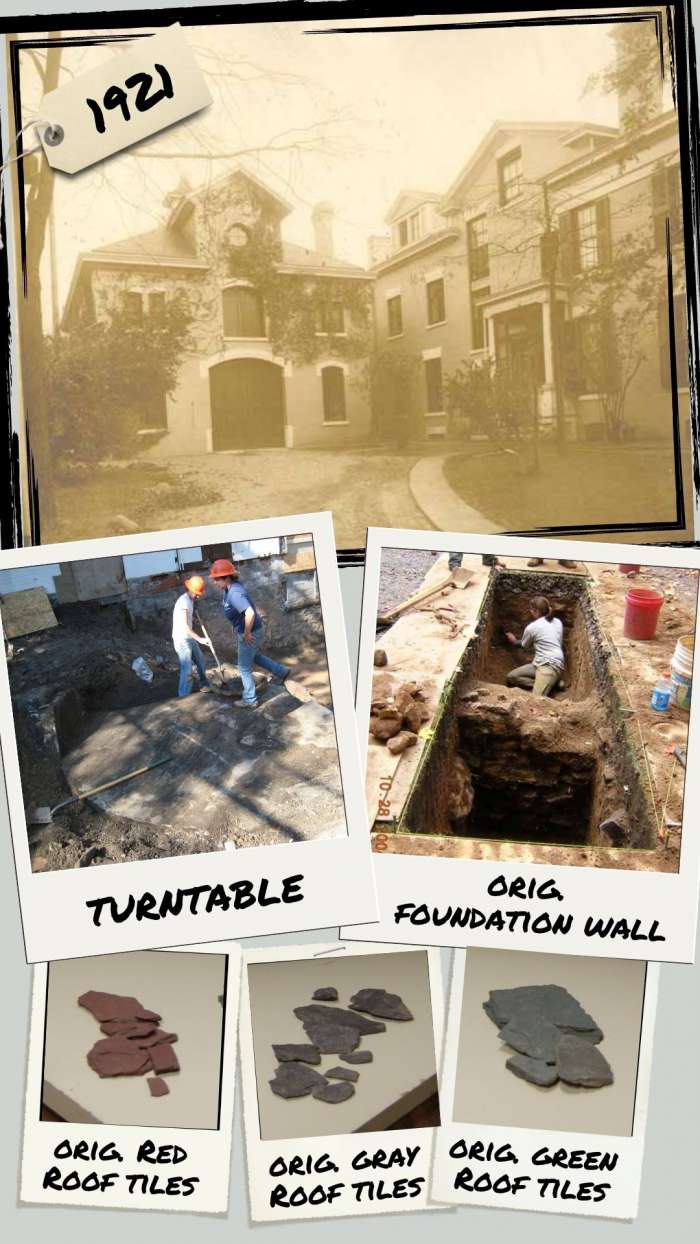
Thankfully new research is always being done, which can yield previously unknown information that confirms long-taught history, offers new perspectives and changes existing narratives, or sometimes a combination of both. This is the case with our Artifact-of-the-Month, a sepia tone photograph from 1921. Donated by Marion Eames (Ansley Wilcox’s granddaughter), it was for many years the only visual record we had of the 19th-century carriage house that TR would have seen in September of 1901. Although the carriage house was torn down in the late 1930’s, the photo became a crucial piece of evidence when the decision to rebuild was made in the early 2000’s. Planning for the reconstructed carriage house (now our visitor center) relied on the photo to replicate the “look” of the original structure as well as its mass. However, the photo had its limitations. It couldn’t provide the architects with the building’s exact dimensions or location; nor could it provide guidance in terms of colors. Finally, we had no way of knowing what the interior of the building looked like.
In jumped the team from UB Archaeological Survey (sometimes literally, as seen in photographs) to help the Site figure out the answers to some of the questions. The first question to answer was the size and location of the carriage house. After consulting historic maps, three trenches were carefully excavated, each positioned such that they would (hopefully) bisect the foundation walls of the original carriage house. And it worked! Each trench revealed remains of the carriage house foundation. This not only established the “footprint” of the original building, but also guided the plans for the new addition.
When examined closely, the 1921 photo provided evidence of a slate roof, but there was no way to tell whether the tiles were all one color, or not. But, archaeologists unearthed several distinct colors of slate roofing tiles and the roof of the new building reflects this discovery.
As construction began on the new carriage house, archaeologists continued to monitor the area. Almost immediately, portions of a mechanical turntable were uncovered. It measured more than 7 feet in diameter and would have been used to turn carriages around. Rumors about such a turntable had long-circulated at the Site, but physical evidence had finally been found to confirm the story!
This is just one example of how historical research is never finished – unlike the typical detective “whodunit” story which usually wraps up neatly at the end. While some of the Site’s questions about the carriage house were answered, it is possible that more evidence will eventually be discovered. For instance, do color photos or views of the interior exist somewhere? There will always be new information to be discovered, new interpretations to be considered, and new perspectives to be considered. But that’s part of what makes history so exciting – you never know what’s coming next!
— Amy Sanderson, Collections Manager