This Artifact-of-the-Month selection was originally posted on Monday, May 2nd, 2022
Following the assassination of President William McKinley, the nation looked for ways to express its grief regarding the sudden death of the immensely popular president. These ranged from letters written to McKinley’s grief-stricken wife, to flowers laid in the Temple of Music where the President was shot, to purchasing a wide variety of memorial souvenirs.* But in McKinley’s hometown of Canton, Ohio, and where he died in Buffalo, New York, thoughts quickly turned to creating large and permanent memorials.
In the weeks following the funeral, several of President McKinley’s closest friends and advisors – including his private secretary George B. Cortelyou, former Secretary of State William R. Day, and Ohio Senator Mark Hanna – met in Canton to propose a fitting memorial to the fallen president that would also serve as his final resting place. By October 10, 1901, a campaign began to raise the $600,000 ($20.3 million today) needed to build the memorial. Such was the popularity of McKinley, that enough money was raised by 1902 to allow the purchase of the property. On June 6, 1905, after less than four years of fundraising, construction of the memorial began. In total, one million individuals donated money to the memorial fund.
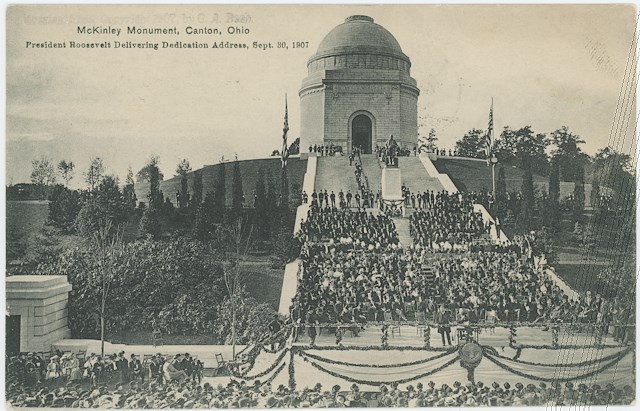
On September 30, 1907, approximately fifty thousand people attended the monument’s dedication, including President Theodore Roosevelt. One of the Artifacts-of-the-Month captures TR speaking at the event. In his speech, TR eulogized his predecessor, saying: “He rose to the foremost place among our statesmen, reaching a position that would satisfy the keenest ambition, but he never lost that simple and thoughtful kindness toward every human being, great or small, lofty or humble, with whom he was brought in contact, which so endeared him to our people.”
Meanwhile, the citizens of Buffalo also felt a responsibility to preserve President McKinley’s legacy with a monument. Although the president was only supposed to be on a short ceremonial visit to the Pan-American Exposition in September of 1901, his assassination made it a landmark event in the city’s history. The city of Buffalo donated a piece of land in Niagara Square – a prominent downtown location at the intersections of Delaware Avenue, Court Street, Genesee Street, and Niagara Street – for the monument. Local officials consulted with noted architect Daniel H. Burnham, who suggested a 96-foot obelisk to maximize the small footprint of the memorial and to stand out among the tall buildings surrounding it. The construction of Buffalo’s McKinley Monument cost $100,000 ($3.3 million today), which was funded by the State of New York.
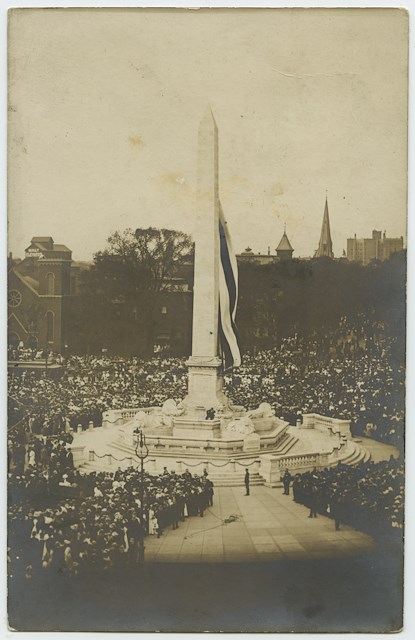
On September 6, 1907, the sixth anniversary of the shooting, an estimated 100,000 people stood in the rain to observe the dedication of the monument by New York Governor Charles Evans Hughes. The scene was captured on the picture postcard that is the second Artifact-of-the-Month
The construction of two significant monuments to President McKinley, both completed within six years of his death, is yet another testament to McKinley’s popularity and how his tragic death was mourned by the nation.
– Amy Sanderson, Collections Manager