This Artifact-of-the-Month selection was originally posted on Tuesday, July 26th, 2016
“What is the most interesting/unique/weird item in your collection?”
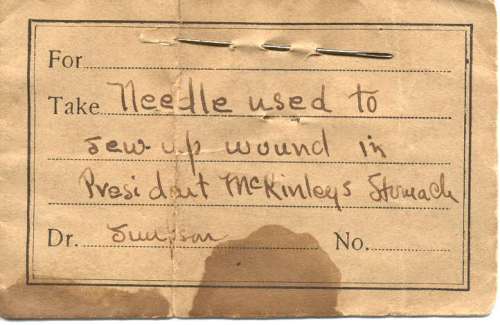
For me, this frequently asked question has a fairly easy answer – the needle used to sew up President McKinley’s stomach. Yes, you read that right. I know the questions that are swirling around. I had the same questions that I had the first time I saw this object, but first a little bit of background.
President William McKinley had been scheduled to appear at the official dedication of the Pan-American Exposition in May 1901, but was unable to attend due to his wife’s illness. Instead he sent Vice-President Theodore Roosevelt, who officiated at the opening ceremonies. As the summer of 1901 drew to a close, organizers of the Pan-Am hoped to reschedule McKinley’s visit to help boost the Exposition’s sagging attendance.
The popular president’s much-anticipated visit to the Pan-Am began on September 5. The largest crowd assembled at the Exposition gathered to listen to McKinley give what was destined to be his last speech. After a trip to Niagara Falls on the morning of September 6, President McKinley and his entourage returned to Buffalo for a public reception at the Temple of Music. Shortly after 4:00 p.m., Leon Czolgosz approached McKinley in the receiving line and shot the President twice. Before he was able to fire a third shot, bystanders knocked Czolgosz to the ground. President McKinley was taken by electric ambulance to the small hospital on the Exposition grounds. Established to treat minor ailments, the hospital was not equipped for major surgery. The doctors who had rushed to the hospital upon hearing the news felt it was too risky to move the President. It was agreed that the surgery should take place at the Exposition hospital.
And this is where our needle comes into the picture. The needle itself is a simple straight needle stuck through a paper envelope with a handwritten note tying it to this historic event. But how do we figure out if this needle is the real thing or whether it is one of the many things tied to McKinley’s assassination after the fact? The major clue was the name “Simpson” written on the envelope. Detailed accounts of the day in the book The Man Who Shot McKinley indicate that Burton T. Simpson, a second year medical student from the University of Buffalo, was on duty at the hospital that day. When the injured President arrived at the hospital, reports indicate that Simpson and another medical student were placed in charge of the instruments so it would seem reasonable that Simpson would have had access to the needle.
To further confirm the potential authenticity of this artifact, the Site reached out to Dr. Jack Fisher, author of Stolen Glory: The McKinley Assassination and a retired surgeon, who was able to verify that several needles would have been used to suture the President’s wound and that after the operation, the needles would have been either discarded or sterilized and used again. It is easy to imagine Simpson taking one of the needles, placing it with a note on a prescription medication envelope, and taking it with him as a tangible reminder of his brush with history.
In every museum’s collection, there are artifacts that have stories attached to them that seem unlikely, but are impossible to either prove or disprove. To have a quirky item (and by most standards, this needle fits in that category) with a verifiable history is a rare find, indeed.
–Amy Sanderson, Collections Manager