This Artifact-of-the-Month selection was originally posted on Wednesday, September 9th, 2020
Note: Digital images of the entire Log Cabin register are available by following this link.
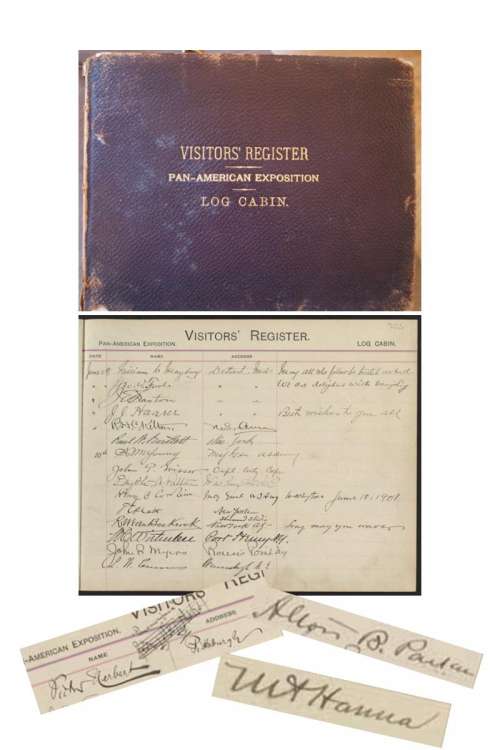
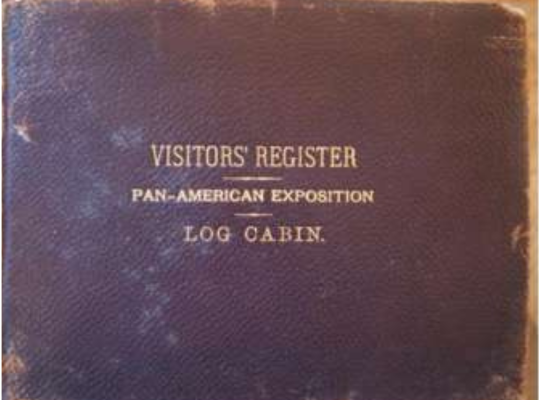
One of the most intriguing items in the TR Site’s collection is a visitors’ log that looks pretty unremarkable at first glance. This book was the guest register from a Pan-American Exposition building called the Log Cabin – a building that none of our staff recognized and that’s difficult to find on maps of the Expo grounds. While the Log Cabin was not the only fair building to have a guest register, this one is unusual in several respects: it is physically smaller than other extant registers (only about 12”W x 9½”H and 1” thick); and it encompasses the fair’s entire 6-month run (May-November, 1901). Records indicate that it was donated by a descendant of George Urban Jr., a member of Pan-Am’s Board of Directors.
Initially, our collections staff was stumped. Pan-Am guidebooks in the Site’s collection didn’t list the Log Cabin, and it was only after a careful reexamination of the collection’s (many) Pan-American Exposition maps that someone noticed a small square labeled “Log Cabin” on one map!!
Nowadays we remember Buffalo’s Pan-American Exposition best for President McKinley’s assassination on September 6, 1901. At the time, the Pan-Am was a massive tourist attraction in its own right, drawing visitors from around the globe. Around eight million people came to visit the fair between May and November, drawn to exhibits and attractions that celebrated the prosperity and success of the Western Hemisphere. Putting on a World’s Fair was an expensive and time-consuming venture that took years of planning and a sizable financial investment. Much of the responsibility for planning the Pan-American fell to its Board of Directors, which ultimately consisted of twenty-five men.
The Log Cabin, it turns out, served as a private retreat for the Board of Directors, where they could host visiting VIPs and also escape the hustle and bustle of the fair. Since the building wasn’t open to the public, it didn’t need to appear on most maps — although that one map in our collection tells us that it was located near Hoyt Lake and the Exposition’s art gallery. We have yet to discover any photos of the Log Cabin, so we’re not sure what it looked like or how big it was. As an exclusive retreat, it was presumably used by the Board members, their families, and the select few they chose to entertain. The Pan-American Board of Directors was composed of prominent Buffalonians, often lawyers and businessmen. They included:
- John G. Milburn, a prominent attorney and President of the Pan-Am Board. President McKinley stayed at the Milburn home during his trip to Buffalo, and it was there that he died on September 14, 1901. The Milburn residence has since been torn down and the lot now belongs to Canisius High School, but its location is still marked with a plaque.
- George L. Williams, a banker with Erie County Savings Bank and Exposition treasurer. He built the house now colloquially known as the Butler Mansion that sits kitty-corner to the TR Site.
- Frank B. Baird, who served as president of both Buffalo’s Chamber of Commerce and the Buffalo Club, contributed to the construction of the Peace Bridge, and served on the University Council for the University of Buffalo.
- Conrad Diehl, Mayor of Buffalo (1898-1901)
- William Hengerer, owner of Hengerer’s department store chain.
- Henry M. Gerrans, co-owner of the Iroquois Hotel Company.
- John Scatcherd, a businessman who made his reputation in lumber, chaired the Pan-Am’s Executive Committee and previously served as president of the Bank of Buffalo.
- Frederick Christopher Martin Lautz, a successful businessman who organized the Buffalo Symphony Orchestra, a precursor to the Buffalo Philharmonic Orchestra we know today.
- Major Thomas W. Symons, a civil engineer who constructed canals and harbors throughout the country, particularly in New York State.
- Harry Hamlin, a wealthy socialite and businessman, known in 1901 as a prolific breeder of horses and known in 2020 for his namesake grandson’s work on L.A. Law
In addition to the Board, the Log Cabin also hosted a number of the Pan-American’s best-known guests, a veritable “who’s who” of famous figures from turn-of-the-20th-century America. They helpfully recorded their visits in the Log Cabin’s guest book. Now an invaluable part of the Site’s collection, this book gives us a view at the crème de la crème of Pan-Am visitors. They included:
- C. Emory Smith, who served as Postmaster General under President McKinley and continued into that role until January, 1902
- E. A. Hitchcock, who served as Secretary of the Interior from 1899-1907
- James Wilson, who served as Secretary of Agriculture for sixteen years (the longest-serving Cabinet secretary in American history!)
- Alton B. Parker, who was Chief Judge of New York State’s Court of Appeals at the time of his visit to the Pan-Am. In a few years, he resigned to run for the presidency, ultimately winning the Democratic nomination in 1904 only to be soundly defeated by a then-incumbent Theodore Roosevelt.
- James W. Wadsworth, a longtime Congressman representing New York
- Samuel Gompers, founder and president of the American Federation of Labor (AFL)
- Finley Peter Dunne, a journalist famous for his satirical character Mr. Dooley; his work was widely syndicated and known throughout the country
- Victor Herbert, a prolific composer who wrote pieces for everything from individual instruments to full orchestras; he is best known for his operettas
- John Philip Sousa, a renowned American composer whose works include many American military marches, including “The Stars and Stripes Forever”
While many of these names resonate today, they would have been even more recognizable to Americans in 1901. This small sample of visitors shows us that people came from all over to visit the Pan-Am, including a number of bona fide celebrities. We can only wonder how this grand event might have been remembered had it not been for President McKinley’s fateful September visit.
— Kelly Brown, Collections Intern | Interpreter