This Artifact-of-the-Month selection was originally posted on Tuesday, May 7th, 2019
The official goal of Buffalo’s 1901 Pan-American Exposition was to commemorate the achievements of the 19th century and “to illustrate the progress and civilization of the nations of the Western Hemisphere.” However, for those visitors not interested in solely the educational aspects of the fair and looking to have a little fun, there was the Midway. The Pan-Am’s Midway was, in 1901 terms, Disney World, the county fair, and the circus all rolled up into one. The Midway occupied thirty acres in the northwest corner of the Exposition grounds. Close to 300 concessionaires vied for the attention (and the money) of visitors. Many Midway attractions were designed solely to amuse, while others allegedly contained some educational value. To which category each exhibit belonged was up to the visitor to decide.
The Midway included rides, displays, entertainment, and restaurants that simulated the culture of other parts of the world. Attractions such as the Philippine Village, Fair Japan, Beautiful Orient (Streets of Cairo), Alt Nürnberg, and Darkest Africa sought to transport the visitor to those places and create an authentic experience. Inspired by Cinco de Mayo, this month’s featured artifact is a rare relic from the Streets of Mexico, run by concessioner H. J. McGarvie and thought by some to be the most elaborate and most expensive attraction on the Midway.
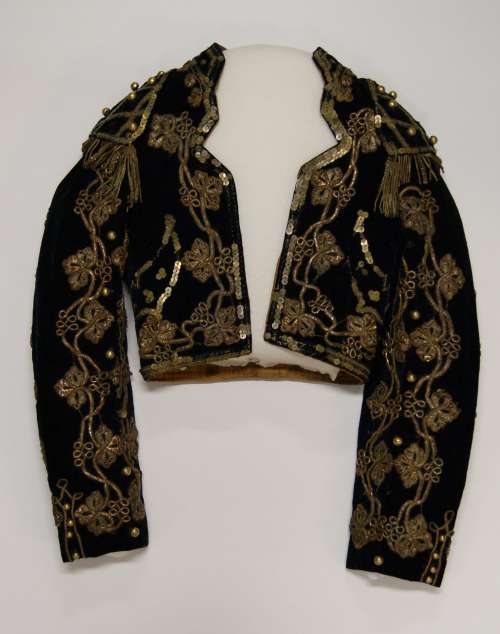
The Streets of Mexico had its own restaurant, and this jacket was worn by Ira Wygart when he worked there as a waiter. The jacket looks like a bullfighter’s jacket and is made out of black velvet. The remarkable thing about the jacket is how small it is. Measuring only 13” across the chest and 16” from the top to bottom edge of the jacket, it is interesting to note that census records suggest that Ira was about 30 years old during the summer of 1901. We don’t know much about his experiences as a waiter at the Pan-Am, but his daughter (who donated the jacket to the Site) says that Ira met his future wife, Elizabeth, also a server in the restaurant, that summer.
To get a feel for the type of food that Ira and Elizabeth served, you can explore the restaurant’s menu here. It included tamales, chili con carne, enchiladas, frijoles, and salsa as well as slightly less Mexican items such as smoked beef tongue, boiled ham and roast spring lamb with mint sauce. The restaurant also served liquor, which we discovered when the Site managed to acquire its original license.
The donation of the waiter’s jacket has led the Site to seek out other ephemera related to the Streets of Mexico for the collection. So far, in addition to the liquor license, the Site has acquired a print of the main entrance, an admission ticket, three postcards, and a souvenir pin. In addition to the restaurant, the Streets of Mexico attraction also included mock bullfights and musical performances, as documented by a souvenir program which includes a schedule of events and photos of the performers.
While the waiter’s jacket alone was an interesting donation (P.S. I would love to know what prompted Ira to keep it for so long), the Site has also been able to use it as inspiration to add items to the collection that can tell a more complete story about this one small aspect of the Pan-Am’s history. For this avowed museum/history geek, being able to use objects to fill out a story is one of the things that makes my job so cool!
— Amy Sanderson, Collections Manager