This Artifact-of-the-Month selection was originally posted on Friday, April 28th, 2023
What do you plan to do right when you retire? For Theodore Roosevelt, his answer was to take a trip to Africa. TR left the White House on March 4th, 1909 and just a few mere weeks later, on March 23rd, he was on his way to British East Africa.
TR’s trip to Africa was not a simple vacation, but a year-long expedition sponsored by the Smithsonian Institution, in which TR would work alongside three naturalists to document and collect specimens of African plants and wildlife, ranging from small beetles to large mammals. By the end of the expedition, The explorers had accumulated an astonishing 11,400 animal items, including 1,000 large animals and 4,000 small mammals. Additionally, 10,000 plant items and a number of ethnological items were collected. This massive collection helped expand the exhibits of the Smithsonian’s Museum of Natural History, which opened its doors in 1910. The natural history museum used TR’s expansive collection to document the African wilderness with specimens mounted to create displays which educated the public on the vastness of the natural world. Duplicate items were also shared with other natural history museums, furthering the reach of scientific education on plants and animals.
What has been fascinating to me is exploring the dualistic mindset TR held in regards to being such an avid hunter, while also being a conservationist. To me, hunting such an extensive amount of wildlife seems incredibly counterintuitive to the conservation efforts promoted during TR’s presidency. However, to him, hunting and conservation were not mutually exclusive. As a young boy, he adored nature, and he expressed this adoration with taxidermy, preserving animal specimens to last a lifetime and beyond. Throughout his entire life, he enjoyed hunting as a hobby and a sport, and argued that “all hunters should be nature-lovers.” He opposed needless cruelty to animals, but regarded his hunting as a scientific endeavor to better learn about wildlife.
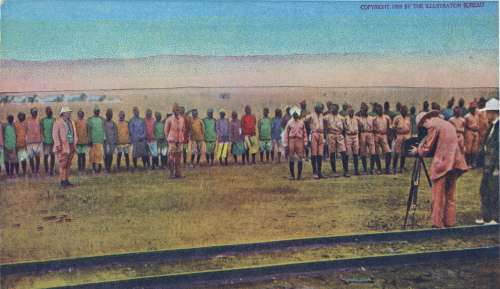
As a father, TR passed on his love of nature and passion for hunting to all his children. His son, Kermit, joined him on the African expedition. The trip served as an opportunity for Kermit to refine his hunting skills, as well as serve as the expedition’s official photographer. In the postcard image, which is the Artifact of the Month, we see Kermit behind the camera, photographing his father, who stands beside the lines of men who served as part of the hunting party and local guides. Many of Kermit’s photographs were illustrated in Scribner’s Magazine, alongside the monthly articles that TR wrote throughout the duration of the expedition. The articles also served as the basis for TR’s book, African Game Trails, which was published after his return from Africa.
TR’s trip to Africa allowed him to set the tone for his post-presidency life, leaving the political spotlight for William Howard Taft, TR’s hand-picked successor. During this trip, he put his skills as a rugged naturalist to good use, tackling any obstacles that came his way and creating a different legacy outside of the presidency.
-Tiffany Stayer, Collections Intern