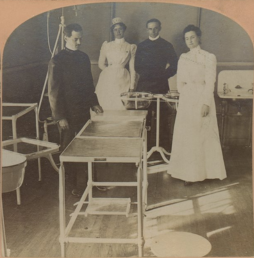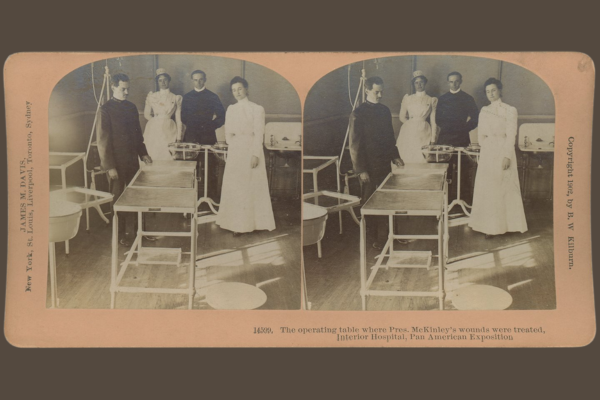
When discussing the Pan-American Exposition and the September 6th attack on President William McKinley and subsequent death on September 14th, I find that oftentimes the actual treatment of President McKinley is overlooked. McKinley’s assassination is told as the segue to Theodore Roosevelt (“TR’s”) rise to the presidency. Knowing that, I felt it important to spotlight this artifact, which is a stereoscopic image taken of the operating table and room where McKinley was treated.
President McKinley was treated in the Pan-American Exposition’s Emergency Hospital. The hospital was built to treat injuries among the millions of expected visitors to the Pan-Am, along with the hundreds of staff that worked on site.
The hospital contained three treatment wards, two for men and one for women. It was outfitted with an operating room and full medical offices. In August, the hospital even began operating a children’s daycare. Visiting parents could drop off their children to be watched by nurses for a price of 25 to 50 cents (equivalent roughly to $9.79 & 19.59 today, respectively in 2026 dollars) depending on how long they stayed. The daycare (known as a “creche”) became a popular service run by the hospital.
The hospital’s operating room, pictured above, was equipped and intended to handle relatively minor procedures. The operating room was built to serve as a place to stabilize patients before they were moved to larger, better equipped Buffalo area hospitals. (I like to think of the Pan-Am hospital similar to a modern day urgent care facility). Which is why, when the fateful events of September 6th occurred, the decision to operate on McKinley became a hotly-debated topic.
McKinley was driven to the hospital by electric ambulance. A hastily-assembled team of doctors and surgeons reached the operating room soon after. Upon examining President McKinley’s wounds, the doctors feared internal bleeding could severely harm the president. Thus, doctors decided to operate on McKinley immediately.
The room was lit only by natural light from a window, and late afternoon sunlight was rapidly fading. Gas lamps were the common source of light at this time, but could not be brought into the O.R. because of the flammable gases powering them. Doctors were forced to race against the clock and rapidly-fading sun. In fact, when the president’s personal physician arrived, he used a metal tray to reflect sunlight onto the surgical site. Later, a singular electric lightbulb was hung above the president. It was an 8-watt lightbulb, the power equivalent of a modern day Christmas tree light.
Looking at the image again, you may be thinking, “Wow, that operating table is quite rickety for a man of McKinley’s size” and you’d be correct in making that assumption! President McKinley weighed 199 lbs. At his height of 5ft 7in, that made him medically obese. Throughout the surgery, doctors struggled to work around McKinley’s weight. In fact, doctors never found the bullet that penetrated McKinley’s abdomen for that exact reason. And, while McKinley did die from his injuries, it is important to note that abdominal injuries at this time were highly deadly. It is also critical to know that the doctors took all appropriate precautions for the time.
Fun fact: the TR Site’s artifact collection actually contains the needle used to sew up President McKinley’s stomach! You can read more about the needle in another blog post here.
Circling back to the present day, think about your own experience. Maybe watching a TV show or even if you have had your own personal time in an operating room. What is different about an operating room today compared to the one pictured above?
– Will DeMartinis, 2026 Gardiner Summer Fellow